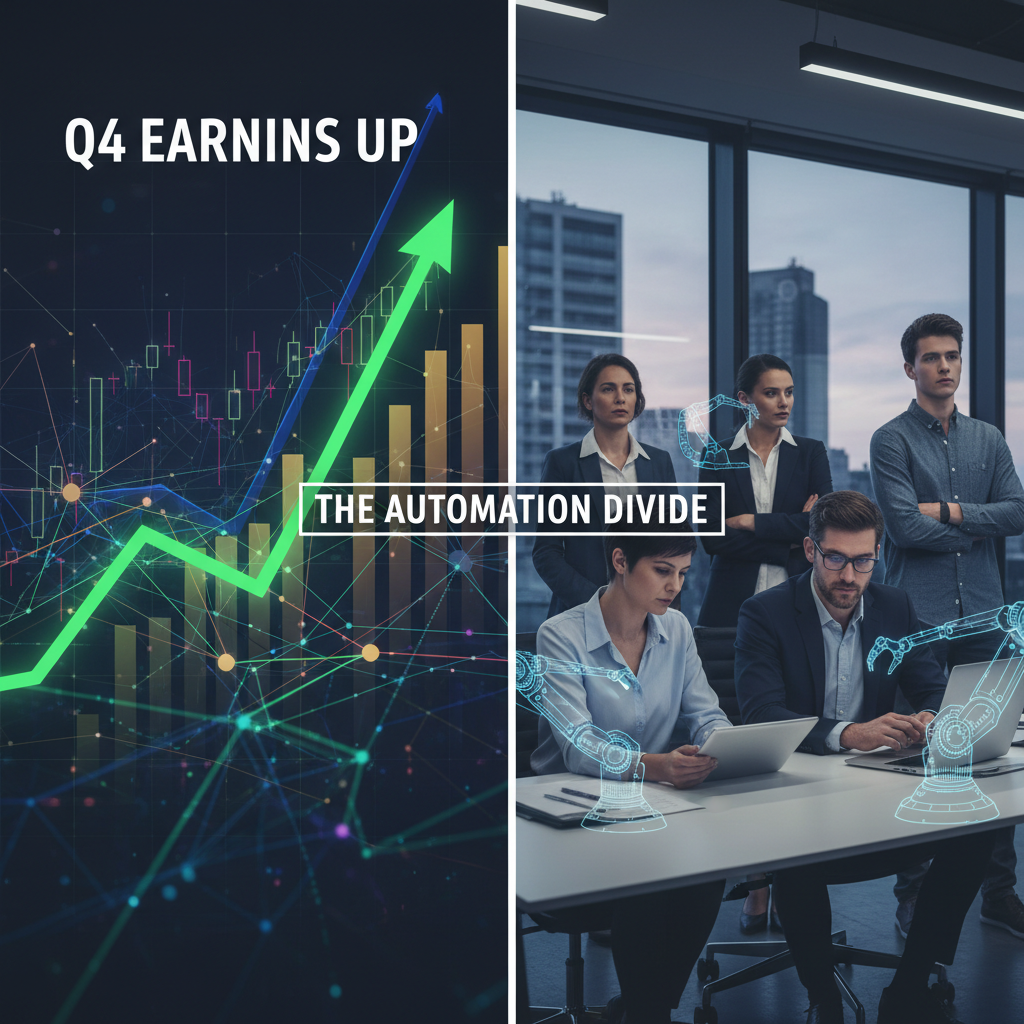
AI's Double-Edged Sword: Q1 2026 Earnings Show Productivity Gains Amidst Labor Market Shifts
NEW YORK, NY – The close of the first quarter of 2026 earnings season has brought into sharp focus the transformative, and at times contradictory, impact of Artificial Intelligence on the global economy. Companies across diverse sectors are reporting significant productivity enhancements and robust profit margins, directly attributing these successes to their substantial AI investments. Yet, this economic optimism is tempered by growing apprehension regarding AI's accelerating influence on labor markets, raising questions about job displacement and the future of work.
AI's Profitability Dividend: Early Returns on Investment
For many corporations, the promise of AI is no longer a distant horizon but a present reality. Major tech giants, financial institutions, and even traditional manufacturing firms have highlighted how AI-driven automation, predictive analytics, and enhanced operational efficiencies have contributed to their strong Q1 2026 performances. For instance, a leading cloud computing provider reported a 15% increase in gross margins, citing AI-powered optimization of data centers and customer service operations. Similarly, an automotive manufacturer showcased how AI-driven design and supply chain management reduced production costs by 8%, directly impacting their bottom line.
Analysts at major investment banks are increasingly incorporating AI integration as a key metric in their corporate valuations. "We're seeing a clear correlation between aggressive AI adoption strategies and superior financial performance," stated Dr. Evelyn Reed, Chief Economist at Global Insights Group. "The initial phase of massive investment is now translating into measurable ROI, particularly in areas like process automation and data-driven decision-making. This trend is likely to accelerate, cementing AI's role as a fundamental driver of corporate profitability for the foreseeable future." This sentiment echoes findings from institutions like the World Economic Forum, which has consistently tracked the economic implications of technological advancements, including AI, in its various reports on the future of jobs and economic growth (see more at weforum.org).
The Shadow of Displacement: AI's Impact on Employment
While corporate balance sheets gleam, the human cost of this technological revolution is becoming increasingly apparent. Reports from various labor market analytics firms indicate a noticeable shift in employment patterns, with certain roles experiencing significant contraction due to AI automation. Entry-level data entry, administrative support, and even some mid-level analytical positions are showing signs of being streamlined or replaced by AI systems. The Bureau of Labor Statistics has begun to publish preliminary data suggesting a divergence in job growth, with high-skill AI-related roles expanding rapidly while others stagnate or decline.
Concerns are particularly acute in sectors like customer service, logistics, and content generation. "The efficiency gains are undeniable, but we must also acknowledge the societal implications," commented Maria Rodriguez, Director of the Future of Work Institute. "We're seeing a growing demand for AI trainers, prompt engineers, and data ethicists, but these new roles don't always absorb the workers displaced from traditional jobs. There's a critical need for robust reskilling and upskilling initiatives to bridge this gap and ensure a just transition for the workforce." This perspective underscores the complex challenge of balancing economic progress with social equity.
Navigating the Future: Policy and Adaptation
Governments and educational institutions are grappling with how to respond to these rapidly evolving dynamics. Discussions around universal basic income, enhanced unemployment benefits, and comprehensive adult education programs are gaining traction. Companies, too, are facing pressure to invest in their existing workforces, providing training in AI literacy and new digital skills. The long-term economic growth potential of AI is immense, but its equitable distribution remains a significant hurdle.
As Q1 2026 earnings confirm AI's powerful influence on corporate profitability, the spotlight now shifts to how societies will adapt to its profound impact on labor. The coming quarters will likely reveal whether the productivity dividends can be leveraged to create new opportunities and mitigate displacement, or if the divide between technological advancement and human employment will widen further. The challenge lies in harnessing AI's power for collective prosperity, ensuring that the benefits of this new era are shared broadly across the economy and society.